ALPACA HOUSING | What should you consider?
Alpacas are true herd animals and should therefore be kept in groups. Ideally, they should have access to an outdoor pasture, as they are not only herd animals but also naturally adapted to living outdoors. There are several important aspects to consider when providing suitable housing for alpacas. Which ones? We explain them in this blog!
Space for alpacas
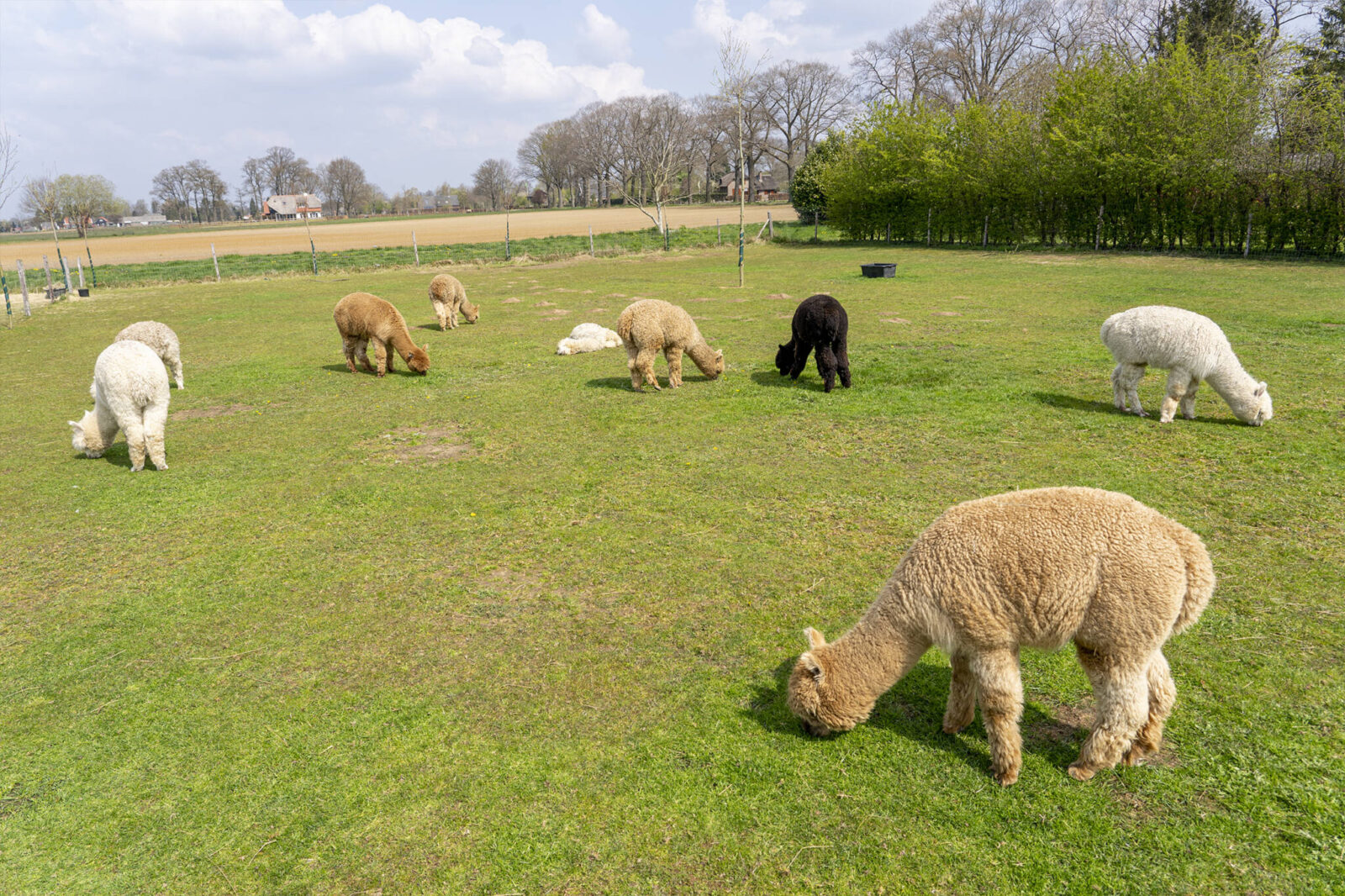
The recommended minimum area for two alpacas is 1,000 m². For each additional alpaca, you should allow an extra 500 m².
Rotational grazing
If you have more space available, you can divide the pasture into several sections and move the alpacas regularly from one section to another. This is known as rotational grazing. It gives the previously grazed area time to recover.
Another benefit for the alpacas is that rotational grazing significantly reduces the risk of worm infestation.
Tip: Always check for poisonous plants in and around the enclosure. Remove them immediately to protect your alpacas.
Sand bath
Alpacas love rolling around in a sand bath. This helps them take care of their skin and coat.
Fencing
The fence around the pasture should be approximately 1.5 metres high and securely installed (fencing or mesh with openings that are not too large). If the alpacas have a thick fleece, electric fencing is generally not very effective.
Open shelter for multiple alpacas
Alpacas can be kept outdoors all year round, provided they have access to shelter. An open-sided shelter is an excellent option for alpacas.
- Provides shade during the summer.
- Offers protection from wind and rain during the winter.
- Allow at least 2 m² of shelter space per alpaca.
- If the alpacas cannot go outside, allow at least 4 m² per alpaca.
- It is useful to have an additional, separate shelter for females with young, sick animals or new arrivals that need to be quarantined.
Roof skylights allow alpacas to make the most of the available daylight and sunlight during the winter months.
Flooring
Straw is a good option for bedding in the shelter. It is hygienic when replaced regularly, although bedding is not essential. Avoid using sawdust or wood chips, as these can become trapped in the fleece. Having a partially paved surface in the enclosure, either indoors or outdoors, helps the alpacas’ toenails wear down naturally.
Feed and drinking water in the enclosure
Half-pipes or gutters can be used as feeding troughs. We recommend allowing approximately half a metre of feeding space per animal. The water trough should be high enough to prevent the animals from standing in it, helping to keep the water clean. To encourage natural feeding behaviour, it is better to offer hay in a feeder on the ground rather than in a hay rack.
Want to know more?
Would you like to know more about housing alpacas, or do you have your own ideas or tips that you would like to share with us and our readers? Send us an email at advies@garvo.nl or give us a call on +31 313 472321.
Garvo alpaca feed range: CLICK HERE
6006 alpaca plus – vitamin and mineral pellet (3 mm)
6003 alpaca muesli – extra energy and nutrients during growth, pregnancy and lactation
6001 alpaca fibre – extra fibre-rich pellet (3 mm) to supplement roughage